SealStack
Signed, hash-chained action records for AI agents, counter-signed by the receiving service and verifiable offline. Not a log you have to trust: evidence you can check.
Repository · PyPI · Specification · Compatibility · Security
SealStack is a Python SDK and a published receipt format. Every action an AI agent takes is written as a record that the agent signs with an Ed25519 key on its own host before the action runs. The records of one process run are hash-chained, so editing, reordering or deleting one is detectable from the records alone. The service that receives a record counter-signs it and returns a receipt. The record, the signatures and the receipt travel together as an evidence bundle that anyone can verify offline with a trust file, and that can be exported to three external receipt formats. The format is published so that others can implement it; it is not a standard.
What it does not prove is stated inside every bundle, byte for byte: that the action really happened in the world, that inputs or outputs were truthful, that the host or key was uncompromised, or that anything was legally authorised. See What is verified, and what is not.
Verify a receipt in 60 seconds
No server, no account. The receipt below is the format's published test vector (SPEC-RECEIPT.md, Section 12); the trust file holds the public key of the service that counter-signed it.
pip install sealstack
curl -sO https://raw.githubusercontent.com/unempyd/sealstack-sdk/main/sdk/tests/fixtures/golden-evidence-bundle.json
curl -sO https://raw.githubusercontent.com/unempyd/sealstack-sdk/main/sdk/tests/fixtures/service-keys.json
sealstack verify golden-evidence-bundle.json --trusted-service-keys service-keys.json
Event hash:              VALID
Agent signature:         VALID
Agent key fingerprint:   VALID
Service receipt:         VALID
Runtime chain:           NOT VERIFIED — predecessor absent
Exit code 0. Now change one character of the service signature and run the same command:
sed -i.orig 's/"signature": "vthO/"signature": "wthO/' golden-evidence-bundle.json
sealstack verify golden-evidence-bundle.json --trusted-service-keys service-keys.json
Service receipt:         INVALID — bundle: service receipt signature does not verify
Evidence bundle:         INVALID — bundle: service receipt signature does not verify
Exit code 1. Change the action name instead and the event hash line fails first. Leave out the trust file and the result is UNKNOWN with exit code 2: the verifier never infers trust from the bundle it is checking. The outputs above were captured from the released package, unedited.
| Exit code | Meaning |
|---|---|
0 |
Cryptographically valid for the supplied evidence |
1 |
Invalid |
2 |
Incomplete or unverifiable |
Install
pip install sealstack
Python 3.11 or later. Dependencies: cryptography, rfc8785, httpx. The
package is sealstack on PyPI; the
import namespace is sealstack (product remains an alias from 0.1.2).
What problem this solves
An application log is a record your own system writes and can change. Nothing inside the file shows whether a row was edited, reordered or removed after the fact, and a reader outside the system that produced it has no way to tell. SealStack records the same actions in a form that differs in three ways:
- Signed before the fact. The agent signs the record with an Ed25519 key held on its own host, before the action runs. Forging a record for a registered agent means holding that private key.
- Chained. Records of one runtime carry the previous record's hash and a sequence number, so removing, reordering or editing one is detectable from the records themselves.
- Counter-signed. The receiving service signs what it accepted, with the acceptance context it resolved at that moment. This is a counter-signature by the receiving service, not an attestation by an independent third party.
The result survives leaving the database it was stored in. The person checking it needs the exported bundle and a list of service verification keys, and nothing else.
How it works
flowchart LR
  subgraph customer["Your infrastructure"]
    direction TB
    agent["Agent process
@audit.track / audit.action"]
    key["identity.json, mode 0600
Ed25519 private seed
never leaves this host"]
    sign["Sign the event
RFC 8785 bytes, SHA-256, Ed25519
previous_event_hash links the chain"]
    queue["audit_queue.db
local SQLite durable queue"]
    agent --> sign
    key --> sign
    sign --> queue
  end

  subgraph service["Receiving service (the reference server)"]
    direction TB
    auth["API key, Bearer token"]
    accept["Acceptance checks
schema, canonical hash,
agent signature, sequence,
previous hash"]
    receipt["Service receipt
signed with the service key"]
    auth --> accept
    accept --> receipt
  end

  subgraph verifier["Verifier, offline"]
    direction TB
    trust["Trust file
/v1/verification-keys,
fetched out of band"]
    check["sealstack verify
makes no network calls"]
    trust --> check
  end

  queue -->|"POST /v1/events/batch"| auth
  receipt -->|"evidence bundle: event, signature,
agent public key, receipt,
service key metadata"| check
Two trust boundaries are worth stating plainly:
flowchart LR
  subgraph host["Agent host"]
    priv["Agent private key"]
    ev["Signed event"]
  end
  subgraph svc["Receiving service"]
    pub["Agent public key (registered)"]
    skey["Service private key"]
    rc["Receipt over event hash + key fingerprint + context"]
  end
  subgraph ver["Verifier"]
    tf["Trust file (service public keys)"]
  end
  priv -. "never crosses" .-> svc
  ev -->|"event + signature"| svc
  pub --> rc
  skey --> rc
  rc -->|"bundle"| ver
  tf --> ver
  skey -. "never crosses" .-> host
- The agent private key never crosses the boundary. It is generated on the
customer host, kept in
identity.jsonat mode 0600, and only its public half is registered. The service can check a signature and counter-sign what it accepted; it cannot produce a record that verifies as the agent's. - The agent cannot forge a service receipt. The verifier resolves the service key only in the trust file it was given, never from the bundle it is checking.
Each record is a closed JSON object (17 fields), canonicalised with RFC 8785 (JCS), hashed with SHA-256 and signed with Ed25519 over the canonical bytes. The receipt is a second closed object signed the same way by the service key. SPEC-RECEIPT.md defines every byte.
What is verified, and what is not
sealstack verify proves three things about a record: that a registered agent
key signed it before the action ran, that it sits where it claims inside its
runtime chain, and that the service signed what it accepted. The exact
13-step procedure, its statuses and exit codes are
Section 10.3 of the specification.
What it does not prove is carried verbatim in every bundle; a bundle whose copy differs is rejected:
This receipt verifies cryptographic relationships between the
included data, registered keys and service receipt.

It does not independently prove:

• that an external real-world action occurred;
• that logged inputs or outputs were truthful;
• that the agent host was uncompromised;
• that the private key was never stolen;
• that uninstrumented actions did not occur;
• the legal identity of a human sponsor;
• that the sponsor personally authorised this individual action;
• legal liability;
• regulatory compliance.
Two further limits of this release: agent key rotation is disabled
(sealstack rotate-key exits 2 and points at v0.2), and the receipt is a
second-party counter-signature, not a third-party transparency-log receipt.
SECURITY.md lists what V1 defends against and what it does not.
Interoperability
sealstack export rewrites one evidence bundle into an external receipt format
and signs the result with the agent key on your machine. Each export was
checked against the format's own verifier on 2026-09-21 with the versions
named below; .github/workflows/test.yml defines an interop job that
rebuilds those verifiers from the same pinned versions.
flowchart LR
  b["SealStack evidence bundle
(native, sealstack verify)"]
  b -->|"sealstack export --format aerf"| a["AERF v0.1.0-draft.1 receipt"]
  b -->|"sealstack export --format agent-receipts"| r["Agent Receipt Protocol 0.5.0 credential"]
  b -->|"sealstack export --format scitt"| n["noa.receipt/0.1 bare receipt"]
  a --> av["aerf-verify (Go), tag and main"]
  r --> rv["obsigna 0.16.0 verify_raw / verify_receipt / verify_chain"]
  n --> nv["noa impl-py/noa_verify.py"]
| Format | Target version | Upstream verifier result | Known limitation |
|---|---|---|---|
| AERF, Agent Evidence Receipt Format | v0.1.0-draft.1 (tag of github.com/aerf-spec/aerf) | Go reference verifier from the tag and from main (v0.2.0-draft.1): full-mode artifact exits 0, tampered copy exits 1; full artifact validates against the upstream aerf-v0.1.json and aerf-v0.2.json schemas |
Non-ASCII evidence text canonicalises differently on the main branch; the golden fixture is ASCII and passes both. No RFC 3161 timestamp. |
| Agent Receipt Protocol | 0.5.0 (agentreceipts.ai, @context v2) |
obsigna 0.16.0: verify_raw, verify_receipt and a two-credential verify_chain accept; tampered copy rejected; its hash_raw_receipt equals SealStack's previous_receipt_hash byte for byte |
obsigna's own current receipt version is 0.6.0 / context v3. No extension slot: the native bundle travels beside the artifact as <artifact>.sealstack.json. |
| noa profile, draft-noa-scitt-ai-agent-receipt-01 | noa.receipt/0.1, bare receipt form |
The noa project's independent Python verifier (impl-py/noa_verify.py, github.com/NordenSoft/noa-mandate-core): VALID for one receipt and for a two-receipt chain, TAMPERED after one field change, MALFORMED for a subset artifact (the four labelled missing members), UNVERIFIED without a keyring; validates against the project's noa-receipt-0.1 JSON schema |
Bare form only: no COSE_Sign1 envelope, no SCITT Signed Statement, no transparency registration. |
The default subset mode omits every field whose semantics SealStack does not
record, writes no placeholder, and labels the artifact non-conformant with the
exact list of missing fields; the upstream schemas and verifiers reject those
artifacts on exactly those fields. Full mode takes an operator mapping file
(example: sdk/tests/fixtures/mapping-full.json) and refuses to write
anything when an action is missing from it. Full-mode conformance therefore
depends on the operator's mapping being truthful: SealStack does not evaluate
policy, classify actions or assess risk. SealStack does not consume any of
these formats; sealstack verify reads only the native bundle.
COMPATIBILITY.md has every field mapping and the exact verifier versions.
Record your own actions
The SDK needs a receiving service. The reference server in this repository runs on your own machine; it is a checkout, not part of the wheel.
git clone https://github.com/unempyd/sealstack-sdk.git && cd sealstack-sdk
pip install -e ".[reference-server]"
SEALSTACK_REF_API_KEY=pick-a-long-random-string \
    uvicorn server:app --app-dir reference-server --host 127.0.0.1 --port 8000
In a second shell:
export SEALSTACK_API_URL=http://127.0.0.1:8000
export AUDIT_API_KEY=pick-a-long-random-string
import os
from sealstack.client import AuditClient

audit = AuditClient(api_key=os.environ["AUDIT_API_KEY"], agent_name="billing-agent")


@audit.track(action="invoice.create", resource_type="invoice", resource_id="INV-2026-0042")
def create_invoice(customer_id, amount_cents):
    return {"invoice_id": "INV-2026-0042", "total": amount_cents}


create_invoice("cust-118", 24900)

with audit.action("ledger.reconcile", resource_type="ledger", resource_id="2026-09"):
    pass  # your own reconciliation work goes here

audit.close()
The first AuditClient generates an Ed25519 key pair on your host, registers
the public half and keeps the private seed in the state directory.
@audit.track writes an action.started record before your function runs
and an action.completed or action.failed record after it returns; it
decorates async functions too. audit.action(...) does the same for a block.
The business function runs exactly once and always returns its own result or
raises its own exception; an audit failure never changes a business outcome
unless you ask for failure_mode="raise".
Receipts land in the local queue next to their events
(<state_dir>/audit_queue.db, column server_receipt). Save the trust file
and assemble a bundle as
reference-server/README.md
describes (the reference-server test does exactly that assembly), then:
curl -s -H "Authorization: Bearer $AUDIT_API_KEY" $SEALSTACK_API_URL/v1/verification-keys > service-keys.json
sealstack verify <bundle>.json --trusted-service-keys service-keys.json
SDK configuration
AuditClient resolves two settings with the same precedence: constructor
argument, then environment variable, then default.
- API base URL:
base_urlargument, thenSEALSTACK_API_URL. There is no default: the constructor raisesValueErrorwhen neither is set. There is no hosted SealStack service; point the SDK at a server you run, such as the reference server in this repository. - State directory:
state_dirargument, thenSEALSTACK_STATE_DIR, then~/.sealstack/<agent_name>.
The reference server is not a production server: one tenant, one bearer key, SQLite storage, no dashboard, no sponsor or capability-grant context, no key rotation, and a signing key that sits on the same machine as the agent. reference-server/README.md states exactly what it checks and what it leaves out.
Specification and conformance
- SPEC-RECEIPT.md: the receipt format, version 1. Records, value profile, canonical encoding, hash chain, receipt (schema 2), evidence bundle (schema 2), trust file, the verification procedure, the limitations text, the golden test vector, and the ten places where the format still assumes a registry or receipt issuer. It is implementable from that document alone; it is not a submitted standard.
sdk/tests/fixtures/receipt-v1.jsonandservice-keys.json: the golden vector with its canonical bytes, derived independently of the SDK bysdk/tests/_fixture_source.py(standard-library JSON pluscryptography).sdk/tests/fixtures/native-vectors.json: conformance vectors for the verifier, each a mutation of the golden bundle with the required exit code and report line; re-signed cases use the public test seeds. Another implementation can consume the file without running the Python tests.sdk/tests/fixtures/limitations.txt: the Section 11 text as exact bytes.- COMPATIBILITY.md: field-by-field export mappings and what was verified against which upstream verifier.
- DEVIATIONS.md: where this SDK differs from the specification.
If you implement the format in another language, the golden vector and the conformance vectors are the acceptance test. Report any sentence of the specification that admits two readings as an issue.
See it working
A 60-second silent film of the SDK, the dashboard application and the verifier: download the MP4 (1920x1080, 2.8 MB).
The two captures below are from the SealStack dashboard application, which is not part of this repository. The reference server has no dashboard; its receipts verify exactly the same way.
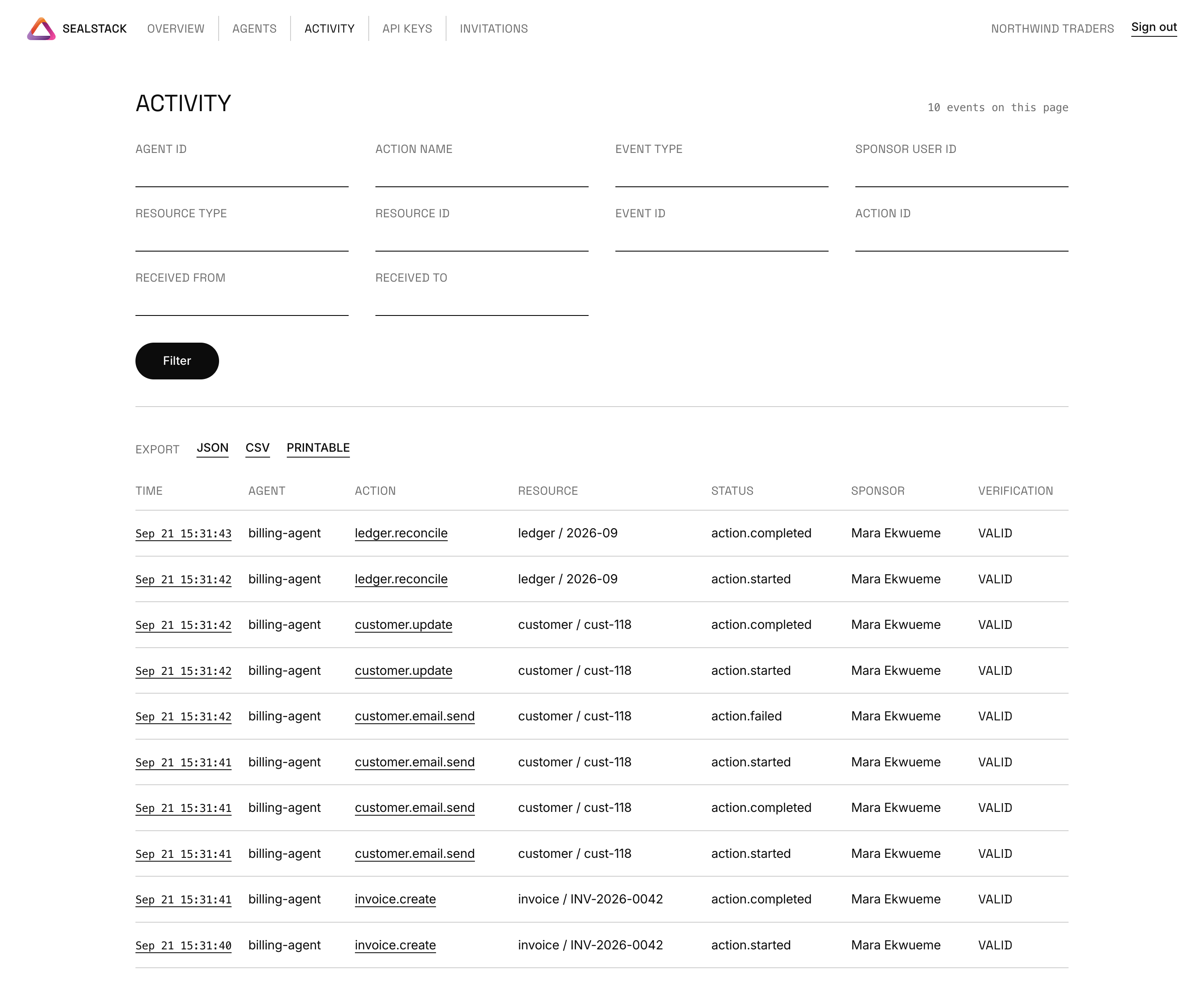
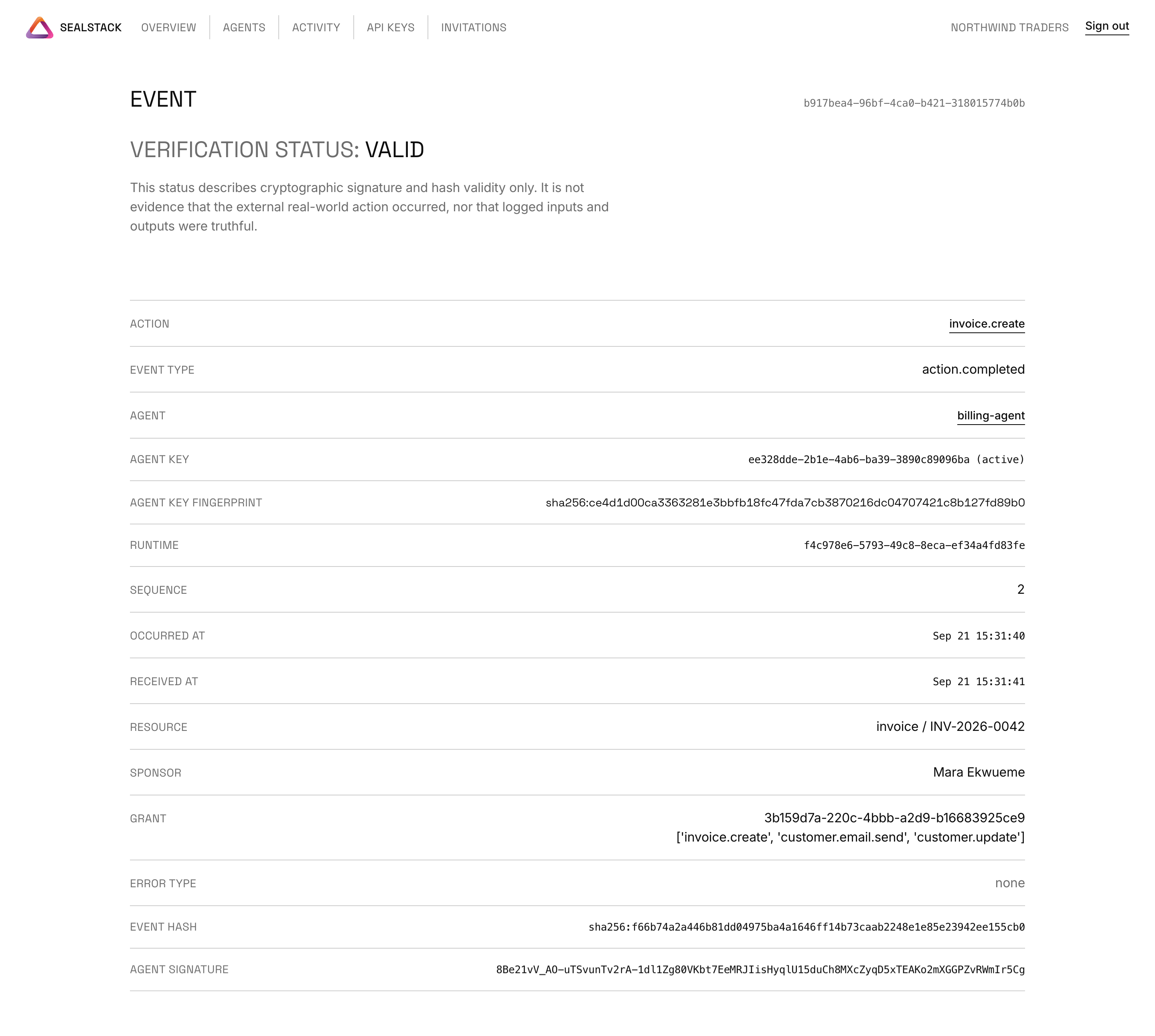
The event page states, directly under its VALID status: "This status describes cryptographic signature and hash validity only. It is not evidence that the external real-world action occurred, nor that logged inputs and outputs were truthful."
Questions a reviewer asks first
Is this just logging with a signature? A signature alone proves who wrote a record. The chain proves order and completeness within a run, and the receipt proves the service accepted that exact record at that time. The verifier checks all three against a trust file it was given out of band, and refuses to read trust from the bundle.
What cryptography is used? RFC 8785 JSON canonicalisation, SHA-256, and Ed25519 (RFC 8032, pure, no prehash) over the canonical bytes. Keys are raw 32-byte public keys, base64url without padding. No other algorithms are accepted.
What happens when evidence is modified? The event hash no longer matches (exit 1), or a signature no longer verifies (exit 1), or a chain link breaks (exit 1). A bundle the verifier cannot judge (unknown service key, missing trust file, unsupported receipt version) is UNKNOWN (exit 2), never VALID.
Can evidence be verified offline? Yes. sealstack verify performs no
network access. It needs the bundle and a trust file.
Is SealStack a standard? No. The format is published so that another implementation can reproduce it, and it exports to three external formats whose own verifiers accept the exports. It has not been submitted anywhere.
Who signs the receipt? The service that received the record. That is a second party, not an independent third party or a transparency log.
Does it help with EU AI Act record-keeping? It produces automatic, tamper-evident records of agent actions, which is the kind of evidence such obligations ask for. SealStack does not assess or prove regulatory compliance; that sentence is inside every bundle.
How does another implementation conform? Reproduce the golden vector
byte for byte, then pass every case in native-vectors.json with the same
exit code.
Security
Report vulnerabilities privately: SealStack@icloud.com or GitHub private vulnerability reporting. SECURITY.md states the trust assumptions and what this release does and does not defend against.
Contributing
CONTRIBUTING.md explains how to run the tests and how to propose a change. The contributions that carry the most weight are an independent verifier in another language written from the specification and the conformance vectors, reports of specification sentences that admit two readings, and upstream-verifier runs whose result differs from COMPATIBILITY.md. This repository is an export of the SDK from the SealStack source repository; merged changes are carried back there and re-exported.
Layout
| Path | Contents |
|---|---|
sdk/sealstack/ |
The SDK, the CLI, the offline verifier and the exporters. |
sdk/product/ |
The pre-0.1.3 import name, kept as an alias of sdk/sealstack/. |
sdk/tests/ |
Native conformance vectors, export-format tests (with the upstream verifier harnesses), the product alias tests and platform tests, with their fixtures. |
reference-server/ |
The minimal single-tenant server described above, and its end-to-end test. |
assets/ |
The mark, the 60-second film, its poster and the dashboard captures. |
pip install -e ".[dev]"
pytest -q
ruff check .
mypy --strict --explicit-package-bases sdk/sealstack reference-server
Apache-2.0. See LICENSE.
This page is generated from the repository README; the repository is the primary source.